
THE DIVIDED SELF : FUNCTIONAL IDENTITY AND DISCONNECTION
BY SERGIO SHAN-LEE | TO BE MORE HUMAN
One reason this form of suffering is so difficult to name is that it can coexist with competence. The divided self is often not chaotic. It can be elegant, articulate, successful, emotionally controlled, and socially reinforced. In fact, it may be rewarded precisely because it knows how to keep pain from disrupting the surface. This is part of what makes it so exhausting. The person is not only carrying life; they are carrying contradiction. They are maintaining roles, relationships, expectations, and responsibilities while feeling less and less integrated within them.The framework of self-connection clarifies this especially well. Klussman et al. (2022) define self-connection as involving three related processes: awareness of oneself, acceptance of oneself, and alignment of one’s behavior with that awareness. The divided self emerges when those three dimensions drift apart. We may know what we feel but not allow it. We may understand ourselves but continue acting against that understanding. We may speak the language of self-awareness while living in ways that remain largely uninhabited. In each case, life can still look coherent from the outside while feeling fragmented from within. The issue is not simply that we are stressed. The issue is that we are split.
SOMETIMES THE SPLIT DOES NOT LOOK LIKE CRISIS
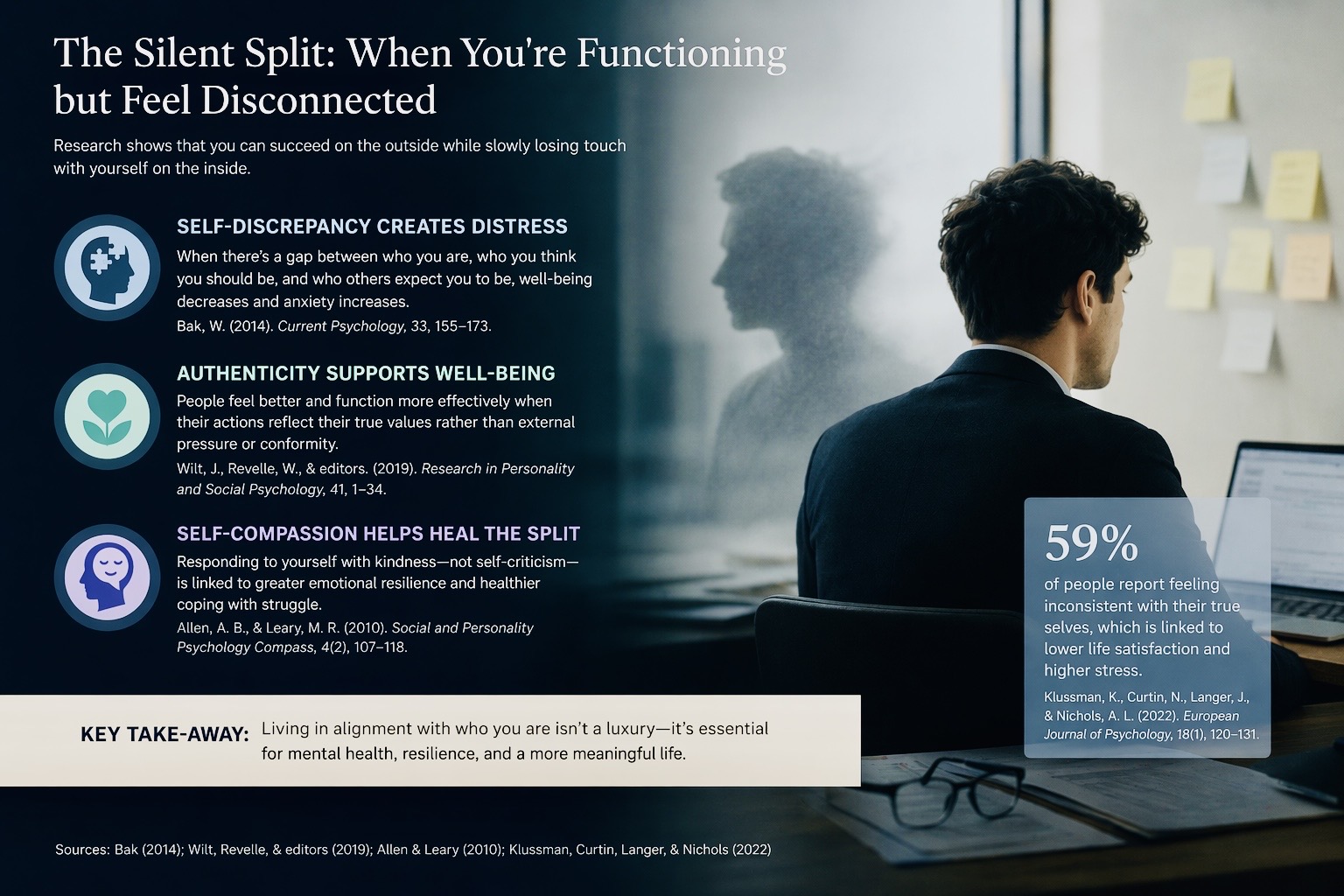
Many of us are taught to recognize distress only when it becomes obvious. We are trained to notice breakdown, collapse, dysfunction, or the visible loss of control. Yet one of the more psychologically difficult forms of suffering is often much quieter than that. A life can continue to function while the self inside it begins to feel increasingly absent. A person may still be productive, responsive, organized, and dependable. They may still be admired. They may still know how to keep everything moving. And yet, somewhere beneath that competence, they may begin to feel strangely unaccompanied by their own life. In psychological terms, this can be understood as a form of inner division: the outward self remains operational while the inward self becomes less represented in the life being lived. Research on authenticity suggests that well-being depends not only on functioning well, but also on experiencing one’s actions as internally owned rather than excessively shaped by suppression, conformity, or external pressure (Wilt et al., 2019).

This matters because the divided self does not always announce itself with drama. Sometimes it arrives as subtle estrangement. We notice that our days are still happening, but they no longer feel fully ours. We notice that we know how to answer, but not always how to speak from within. We notice that life still works, but it is becoming harder to feel present inside what is working. The pain here is not necessarily failure. Often, it is distance.
THE DIVIDED SELF USUALLY BEGINS AS ADAPTATION
For many of us, this split does not begin in dishonesty. It begins in adaptation. We learn how to become understandable to the environments around us. We learn how to soften what is inconvenient, manage what is intense, and present versions of ourselves that are easier to receive. We learn what earns approval, what preserves connection, what avoids conflict, and what keeps us emotionally legible to others. In many contexts, these adaptations are intelligent. They may be relationally protective, socially necessary, or emotionally strategic. The problem begins when they stop being flexible responses and become fixed structures of identity. This is where self-discrepancy becomes a useful psychological lens. Self-discrepancy research suggests that distress can emerge when there are significant gaps between aspects of the self, including who we experience ourselves to be and who we feel we should, ought, or are expected to become (Bak, 2014).

The divided self often grows in those gaps. We continue living outwardly in ways that fit obligation, expectation, or performance while inwardly experiencing a growing separation from what feels true, wanted, or fully ours. Over time, the cost of that split can deepen, even when life remains externally intact.
THE HARDEST PART IS THAT THE DIVIDED SELF CAN FUNCTION BEAUTIFULLY
One reason this form of suffering is so difficult to name is that it can coexist with competence. The divided self is often not chaotic. It can be elegant, articulate, successful, emotionally controlled, and socially reinforced. In fact, it may be rewarded precisely because it knows how to keep pain from disrupting the surface. This is part of what makes it so exhausting. The person is not only carrying life; they are carrying contradiction. They are maintaining roles, relationships, expectations, and responsibilities while feeling less and less integrated within them. The framework of self-connection clarifies this especially well.

Klussman et al. (2022) define self-connection as involving three related processes: awareness of oneself, acceptance of oneself, and alignment of one’s behavior with that awareness. The divided self emerges when those three dimensions drift apart. We may know what we feel but not allow it. We may understand ourselves but continue acting against that understanding. We may speak the language of self-awareness while living in ways that remain largely uninhabited. In each case, life can still look coherent from the outside while feeling fragmented from within. The issue is not simply that we are stressed. The issue is that we are split.
AWARENESS OFTEN MAKES THE SPLIT HURT MORE BEFORE IT MAKES IT HEAL
There is a common hope that once we become aware of our inner division, things will begin to resolve. Sometimes they do, but not immediately. Awareness often intensifies discomfort before it reduces it. Once we see the split clearly, certain ways of living become harder to tolerate. A yes that covers an inward no begins to feel heavier. A role that once felt protective begins to feel confining. A life that once seemed stable begins to feel performative. Awareness changes what we can bear. This is one reason authenticity is a deeper construct than self-expression alone.

Authenticity is not simply saying more of what we think or feel. It is also about experiencing our lives as internally owned rather than organized primarily around suppression, conformity, or externally driven performance (Wilt et al., 2019). Once the question of ownership becomes active, appearance loses some of its authority. We begin to care less about whether our lives look coherent and more about whether they feel inhabited. That shift is often the beginning of psychological tension, but it is also the beginning of truth.
THE TASK IS NOT SIMPLY EXPRESSION, BUT INTEGRATION
If division is the problem, then integration is the task. But integration is not the same as total self-disclosure, dramatic reinvention, or emotional rawness. It is something quieter and more exacting than that. Integration means reducing the distance between what we know inwardly and how we live outwardly. It means allowing awareness to become livable. It means that self-knowledge is no longer held only in private while behavior remains organized around contradiction.This is why alignment matters so much in the psychology of the divided self. Klussman et al. (2022) make clear that awareness and acceptance are not sufficient on their own; behavior also has to come into relationship with what is known. A person becomes less divided when they do not only understand themselves more clearly, but gradually begin to act in ways that reflect that understanding. Psychological flexibility adds another important dimension here.

Kashdan and Rottenberg (2010) argue that psychological flexibility is a core aspect of health because it involves openness to experience, adaptation to changing demands, and the ability to persist or shift behavior in ways that remain connected to personal values. In this sense, integration is not rigidity. It is not becoming fixed. It is becoming more responsive to what is deeply true rather than merely socially sustainable.
THE DIVIDED SELF DOES NOT HEAL THROUGH SELF-ATTACK
One of the more painful patterns many of us fall into is this: as soon as we begin to see our own fragmentation clearly, we turn that recognition into a reason to be harsher with ourselves. We feel ashamed that we adapted so much. Embarrassed that we performed. Angry that we stayed distant from ourselves for so long. We begin to speak to ourselves as though our survival strategies were moral failures. But self-attack rarely produces wholeness. More often, it produces another layer of division. Research on self-compassion suggests that people cope more effectively when they respond to suffering with kindness, emotional balance, and recognition of shared humanity rather than condemnation (Allen & Leary, 2010).

That does not mean excusing everything or refusing accountability. It means understanding that many divided ways of living were learned before they were fully chosen. Some performances began as attempts to preserve attachment. Some forms of self-suppression began as ways of remaining safe. Some distances from the self were once necessary to endure what could not yet be fully felt. Integration becomes more possible when honesty is strong enough to remain merciful. The self does not become whole by being punished for having once survived partially.
A MORE HUMAN LIFE MAY SIMPLY BE A LESS DIVIDED ONE
This may be the more psychologically useful vision of growth. Not perfection. Not a more impressive identity. Not a better performance under a more attractive vocabulary. But a life that becomes less internally split over time. From this perspective, becoming more human does not mean becoming more polished. It means becoming more inhabitable to oneself. It means narrowing the distance between what we feel and what we permit, between what we know and what we enact, between the life that appears coherent and the life that feels lived from within.This is also a more inclusive understanding of change. It does not assume that growth belongs only to those in visible crisis. It speaks equally to many of us who are functional, caring, and outwardly stable, yet still feel a mismatch between our inward life and outward form. Psychological research across authenticity, self-discrepancy, self-connection, self-compassion, and flexibility converges on this broader point: suffering is often intensified not only by pain itself, but by the internal distances we are carrying while trying to remain functional (Allen & Leary, 2010; Bak, 2014; Kashdan & Rottenberg, 2010; Klussman et al., 2022; Wilt et al., 2019). Growth, then, may be less about becoming someone entirely new and more about becoming less absent from the life that is already ours.
WHAT THE DIVIDED SELF ASKS OF US
The divided self does not always ask us to overthrow our lives. More often, it asks for recognition. It asks us to notice where performance has become more practiced than presence. It asks us to see where our competence has hidden our estrangement. It asks us to become more honest about the distance between the self that functions and the self that feels real. Then, slowly, it asks something more demanding and more humane: not perfection, but participation. A little more truth in action. A little more ownership in speech. A little more compassion toward the parts of us that learned division in order to endure.Perhaps that is the quieter work underneath so much psychological healing. Not becoming extraordinary. Not becoming flawless. Not becoming someone else entirely. But becoming less divided. Becoming more able to remain in contact with ourselves while we live. Becoming more able to inhabit what we already know. Becoming, in the deepest sense, more human.
REFERENCES
Allen, A. B., & Leary, M. R. (2010). Self-compassion, stress, and coping. Social and Personality Psychology Compass, 4(2), 107–118. https://doi.org/10.1111/j.1751-9004.2009.00246.xAccessible full text: PubMed Central
Bak, W. (2014). Self-standards and self-discrepancies: A structural model of self-knowledge. Current Psychology, 33(2), 155–173. https://doi.org/10.1007/s12144-013-9203-4Accessible full text: PubMed Central
Kashdan, T. B., & Rottenberg, J. (2010). Psychological flexibility as a fundamental aspect of health. Clinical Psychology Review, 30(7), 865–878. https://doi.org/10.1016/j.cpr.2010.03.001Accessible full text: PubMed Central
Klussman, K., Curtin, N., Langer, J., & Nichols, A. L. (2022). The importance of awareness, acceptance, and alignment with the self: A framework for understanding self-connection. Europe’s Journal of Psychology, 18(1), 120–131. https://doi.org/10.5964/ejop.3707Accessible full text: PubMed Central
Wilt, J. A., Thomas, S., & McAdams, D. P. (2019). Authenticity and inauthenticity in narrative identity. Heliyon, 5(7), e02178. https://doi.org/10.1016/j.heliyon.2019.e02178Accessible full text: PubMed Central