
WHAT STILLNESS TEACHES US:
BY SERGIO SHAN-LEE | TO BE MORE HUMAN
Stillness is often treated as a lifestyle preference, yet psychological science frames it more precisely as a trainable mode of attention and awareness closely aligned with mindfulness. In operational terms, mindfulness emphasizes self-regulation of attention toward present-moment experience and an open, accepting orientation to what is noticed, which distinguishes “stillness” from mere inactivity or suppression. [1] Mindfulness-based interventions (MBIs) show consistent (typically small-to-moderate) benefits for negative dimensions of psychological stress, with stronger evidence for outcomes such as anxiety and depression than for many objective or physiological endpoints. [2] Contemporary mechanism models converge on the idea that stillness practices strengthen attentional control, shift the relationship to thoughts and emotions (decentering/reperceiving), and support emotion regulation processes, with plausible neurobiological correlates in control and salience networks. [3] Brief, scalable practices can reduce short-term stress in large experimental studies, but research and clinical guidance emphasize realistic expectations, attention to fit, and awareness that adverse or distressing experiences can occur for a minority of practitioners. [4]
CONCEPTUALIZING STILLNESS IN PSYCHOLOGICAL SCIENCE
In psychological writing, “stillness” is not a single standardized construct; it functions best as a phenomenological descriptor for a state in which external doing is reduced to allow clearer contact with internal experience. Research most directly maps stillness onto mindfulness, defined in the APA Dictionary of Psychology as awareness of one’s internal states and surroundings. [5] A widely cited operationalization further specifies mindfulness as a two-component process: (a) self-regulation of attention maintained on immediate experience, and (b) an orientation to experience characterized by curiosity, openness, and acceptance. [6]
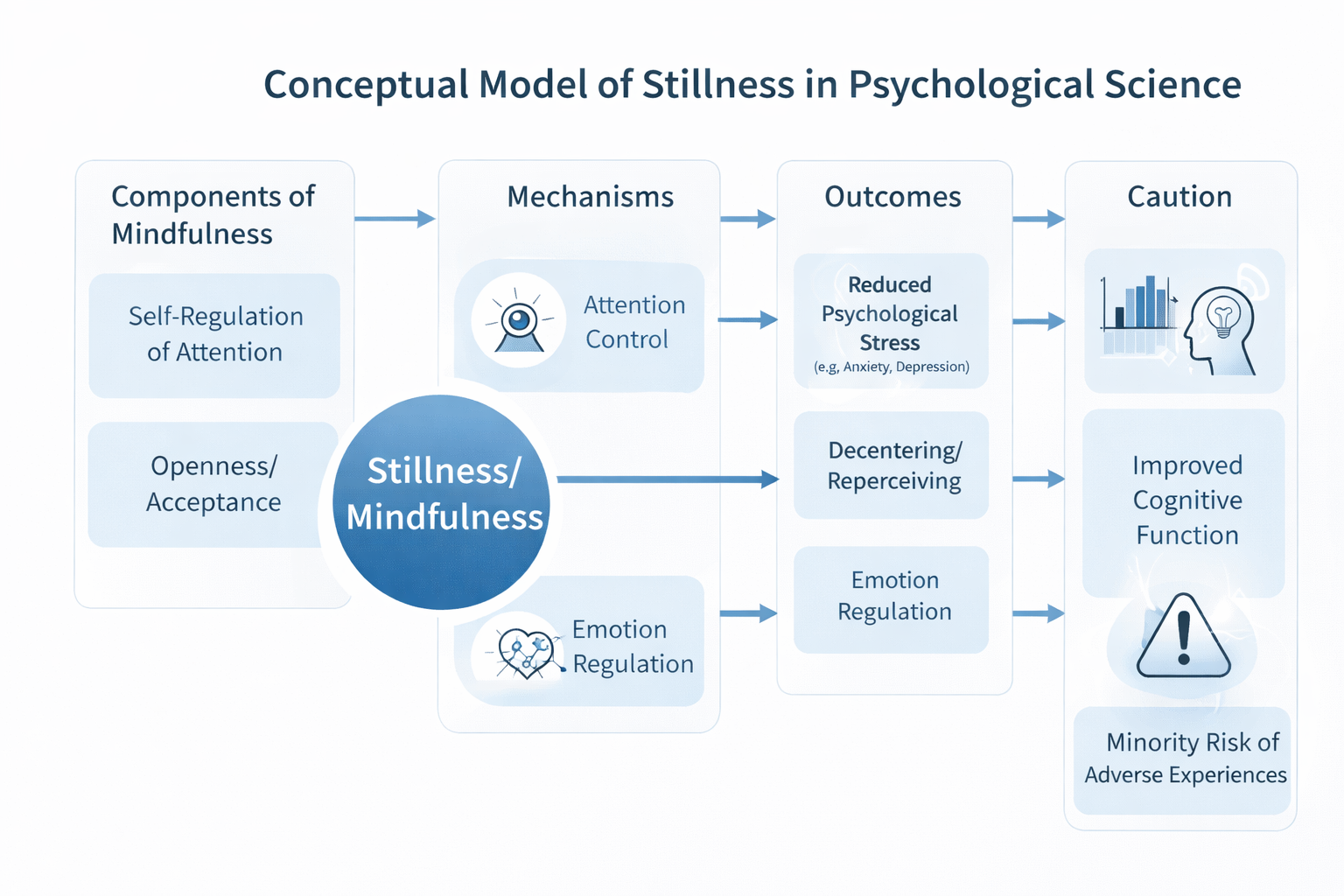
Figure 1. Conceptual Model of Stillness in Psychological Science. This model is showing how core components of mindfulness—self-regulation of attention and openness/acceptance—support mechanisms such as attention control and emotion regulation, which in turn relate to reduced psychological stress, decentering, improved cognitive function, and the need for caution regarding adverse experiences in a minority of practitioners.
Illustrated By To Be More Human
This framing matters because it differentiates psychologically meaningful stillness from simply “sitting quietly” while the mind perseverates, ruminates, or dissociates. Contemporary theorizing also clarifies that mindfulness can be discussed as a state, trait/disposition, process, practice, or intervention, each with different measurement implications. [7] Vago and Silbersweig’s S-ART model (self-awareness, self-regulation, self-transcendence) integrates these perspectives by proposing that systematic mental training strengthens meta-awareness and self-regulatory capacity while reducing bias in self-processing. [8] In this view, stillness is not mainly about “calming down”; it is about training the mind to notice what it is doing, interrupt automaticity, and relate to experience with greater flexibility. Mechanism-focused theories add a clinically useful layer: stillness practices are hypothesized to change outcomes not primarily by replacing thoughts or emotions, but by changing the relationship to them. Shapiro and colleagues describe a shift they term “reperceiving,” in which thoughts and feelings are experienced more as events in consciousness than as literal truths or commands, supporting clarity and equanimity. [9] Hölzel and colleagues similarly propose that mindfulness operates through attention regulation, body awareness, emotion regulation (including reappraisal- and exposure-like processes), and change in perspective on the self. [10] Together, these models justify treating stillness as an active psychological skill—an intentional stance that can be practiced, refined, and evaluated.
EVIDENCE FOR MENTAL HEALTH AND COGNITIVE OUTCOMES
Across high-quality evidence syntheses, MBIs show their most consistent effects on negative dimensions of psychological stress. In a landmark systematic review and meta-analysis, mindfulness meditation programs demonstrated moderate evidence for small improvements in anxiety, depression, and pain, along with lower-evidence improvements in stress/distress and mental health–related quality of life when compared with nonspecific active controls. [11] Importantly, the same review highlights methodological constraints (e.g., variable trial quality, limited reporting of harms) that temper overly broad claims and encourage realistic expectations. [12] A later meta-review compiling results across many meta-analyses reinforces a nuanced conclusion: MBIs generally compare favorably with passive controls across many populations and outcomes, but effects are typically smaller and less consistently significant when compared with active controls, and evidence is weaker for objective and physiological measures. [13] This pattern supports a careful interpretation of “what stillness teaches”: benefits are plausible and often meaningful, but they are not uniformly large, and they depend on what outcomes are measured and what MBIs are compared against. Evidence is especially developed for relapse prevention in recurrent depression using mindfulness-based cognitive therapy (MBCT). An individual patient data meta-analysis reported that MBCT reduced risk of depressive relapse within a 60-week follow-up compared with non-MBCT conditions and showed comparable outcomes to other active approaches in relapse prevention. [14] The implication for a stillness-centered thesis is not that stillness “cures” depression, but that training attention and decentering within structured clinical models can alter vulnerability pathways implicated in relapse. Cognitive outcomes are increasingly evaluated with rigorous synthesis methods. A large meta-analysis of 111 randomized controlled trials found small-to-moderate effects of MBIs on global cognition and several accuracy-based domains (e.g., executive attention, sustained attention accuracy, working memory accuracy), with smaller effects against active controls than against waitlist/no-treatment comparisons. [15] This evidence supports the idea that stillness practices may sharpen cognitive functioning primarily by improving quality and stability of attention, rather than by universally increasing speed or raw capacity. Finally, newer “brief and scalable” formats show measurable short-term effects, while also underscoring the need to distinguish immediate state shifts from longer-term skill acquisition. A systematic review of brief MBIs concluded that even single-session interventions as short as five minutes can impact health-related outcomes, despite substantial heterogeneity in methods and measures. [16] In a large preregistered multi-site experiment, several standalone mindfulness exercises reduced self-reported short-term stress relative to an active control, with the body scan condition yielding the largest stress reduction in that test set. [17] These findings justify including brief practices in a stillness “toolkit,” while maintaining scientific caution about generalization and durability.
MECHANISMS LINKING STILLNESS TO CHANGE
Mechanistic explanations of stillness are strongest when they remain consistent with both cognitive psychology and affective neuroscience: stillness practices repeatedly train where attention goes, how quickly it returns, and what happens when difficult internal states arise. Hölzel and colleagues propose that mindfulness exerts effects through attention regulation, body awareness, emotion regulation (including reappraisal-like and exposure-like mechanisms), and a changed perspective on the self, with neuroimaging evidence pointing toward involvement of regions such as the anterior cingulate cortex, insula, fronto-limbic circuits, and default mode network structures. [10] From a stillness lens, these components can be interpreted as a progression from “noticing experience” to “staying with experience” to “responding more flexibly to experience.”
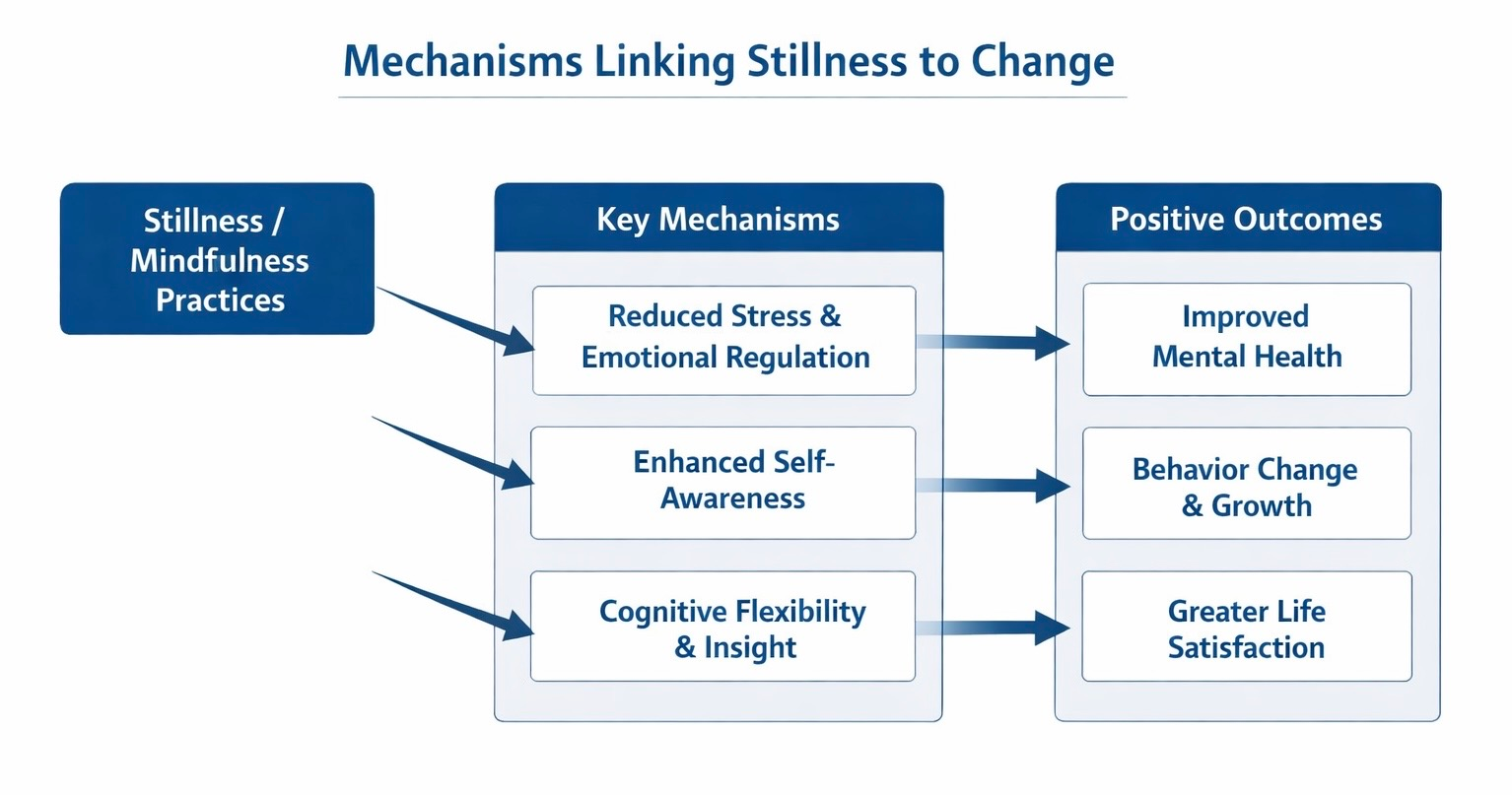
Figure 2. Mechanisms linking stillness to change, illustrating how stillness or mindfulness practices may contribute to reduced stress and emotional regulation, enhanced self-awareness, and greater cognitive flexibility and insight, with downstream benefits for mental health, behavior change, growth, and life satisfaction.
Illustrated By To Be More Human
The attentional pathway is central: stillness practices typically require repeated detection of mind-wandering and deliberate reorientation to a chosen anchor or monitoring stance. In the S-ART model, such practice is expected to strengthen integrative control networks that support meta-awareness and self-regulation. [8]Mechanistically, the functional consequence is a reduced tendency for attention to be dominated by self-referential narrative loops and a greater capacity to stabilize awareness in the present, which aligns with why stillness is subjectively experienced as “coming back” rather than “checking out.” [19] Emotion regulation provides a second pathway that connects stillness to mental health outcomes. Reperceiving (or decentering) implies that thoughts and emotions can be held in awareness without immediate identification or escalation, creating a psychological “space” in which a person can choose responses rather than enact reflexes. [20]Hölzel’s model strengthens this claim by linking mindfulness to both cognitive reappraisal processes and exposure-like learning (staying with discomfort long enough for reactivity to change), supporting the clinical observation that stillness can reduce avoidance-driven cycles when practiced safely and consistently. [10] A third pathway involves stress physiology, where the evidence base is suggestive but limited. In a meta-analysis focused on salivary cortisol, MBIs showed a modest overall effect consistent with reduced cortisol, while the authors emphasize the small number of included RCTs and methodological heterogeneity as major constraints. [21] This supports a cautious interpretation: stillness may influence stress reactivity for some people, but biomarker conclusions remain less mature than symptom-level findings.
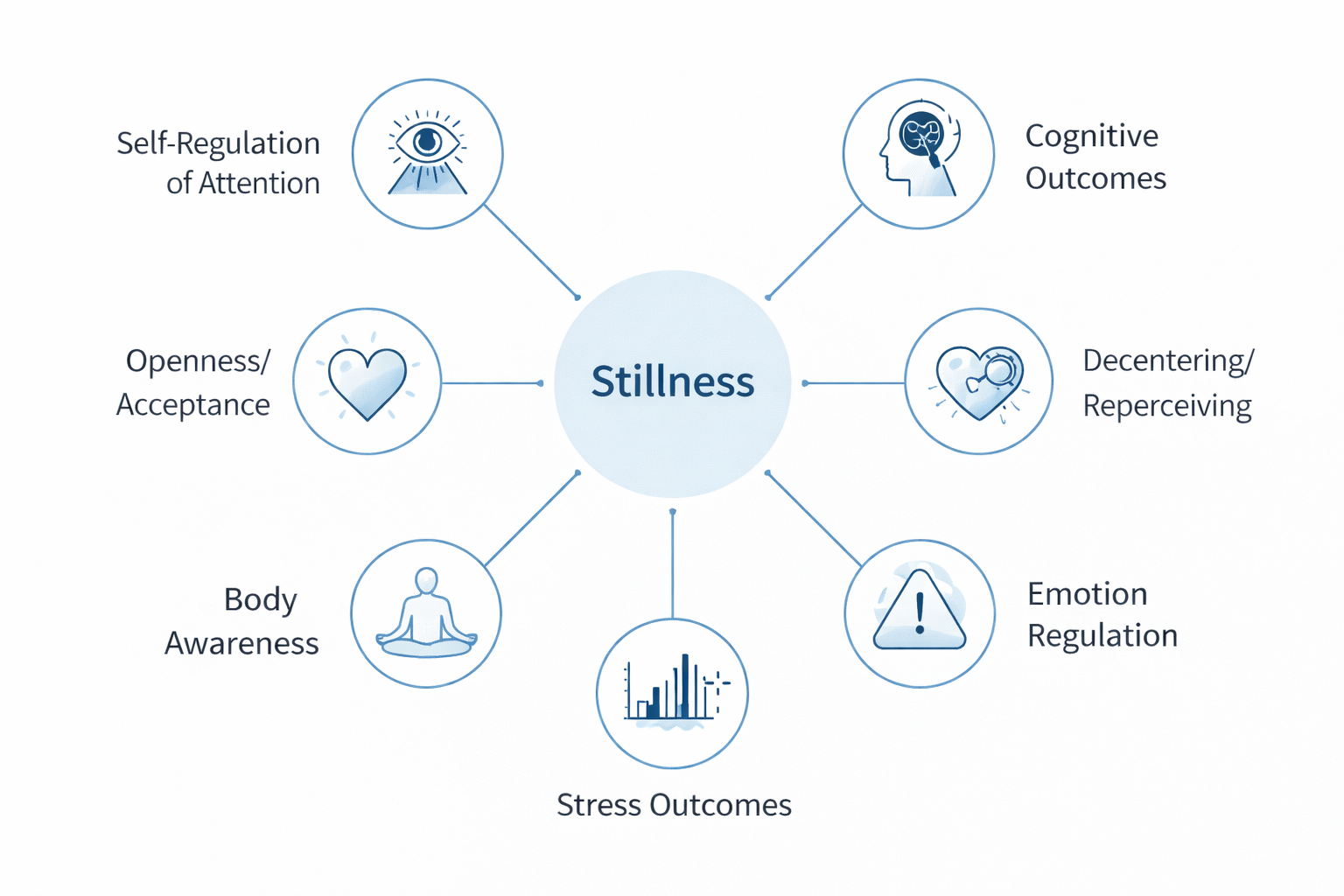
Figure 3. Summary Map of Stillness in psychological science, depicting stillness as a central integrative process associated with self-regulation of attention, openness and acceptance, body awareness, decentering or reperceiving, emotion regulation, and downstream stress and cognitive outcomes.
Illustrated By To Be More Human
Conclusion: “What stillness teaches” is not that psychological distress can be eliminated through quiet, but that the mind’s relationship to experience can be changed through systematic attention and awareness training. Definitions and models converge on a view of stillness-as-mindfulness that is active rather than passive: attention is intentionally regulated, experience is met with openness, and thoughts and feelings are held with more perspective. [34] Meta-analytic evidence indicates that MBIs tend to reduce negative stress-related outcomes and may modestly enhance cognitive functioning, while effects vary by comparator type, outcome domain, and implementation quality. [35] The most defensible professional conclusion is both hopeful and bounded: stillness is a teachable psychological capacity with meaningful benefits for many people, alongside known limitations and a nontrivial minority risk of challenging experiences that require appropriate framing and support. [36]
REFERENCES
American Psychological Association. (2018, April 19). Mindfulness. APA Dictionary of Psychology. Open webpage.
Bishop, S. R., Lau, M., Shapiro, S., Carlson, L., Anderson, N. D., Carmody, J., Segal, Z. V., Abbey, S., Speca, M., Velting, D., & Devins, G. (2004). Mindfulness: A proposed operational definition. Clinical Psychology: Science and Practice, 11(3), 230–241. Abstract page.
Goldberg, S. B., Riordan, K. M., Sun, S., & Davidson, R. J. (2022). The empirical status of mindfulness-based interventions: A systematic review of 44 meta-analyses of randomized controlled trials. Perspectives on Psychological Science, 17(1), 108–130. Free full text.
Goyal, M., Singh, S., Sibinga, E. M. S., Gould, N. F., Rowland-Seymour, A., Sharma, R., Berger, Z., Sleicher, D., Maron, D. D., Shihab, H. M., Ranasinghe, P. D., Linn, S., Saha, S., Bass, E. B., & Haythornthwaite, J. A. (2014). Meditation programs for psychological stress and well-being: A systematic review and meta-analysis. JAMA Internal Medicine, 174(3), 357–368. Free full text.
Howarth, A., Smith, J. G., Perkins-Porras, L., & Ussher, M. (2019). Effects of brief mindfulness-based interventions on health-related outcomes: A systematic review. Mindfulness. Free full text.
Hölzel, B. K., Lazar, S. W., Gard, T., Schuman-Olivier, Z., Vago, D. R., & Ott, U. (2011). How does mindfulness meditation work? Proposing mechanisms of action from a conceptual and neural perspective. Perspectives on Psychological Science, 6(6), 537–559. Abstract page.
Kuyken, W., Warren, F. C., Taylor, R. S., et al. (2016). Efficacy of mindfulness-based cognitive therapy in prevention of depressive relapse: An individual patient data meta-analysis from randomized trials. JAMA Psychiatry, 73(6), 565–574. Free full text.
Lindahl, J. R., Fisher, N. E., Cooper, D. J., Rosen, R. K., & Britton, W. B. (2017). The varieties of contemplative experience: A mixed-methods study of meditation-related challenges in Western Buddhists. PLOS ONE, 12(5), e0176239. Free full text.
National Center for Complementary and Integrative Health. (2022, June 3). Meditation and mindfulness: Effectiveness and safety. Open webpage.
Sanada, K., Montero-Marin, J., Alda Díez, M., et al. (2016). Effects of mindfulness-based interventions on salivary cortisol in healthy adults: A meta-analytical review. Frontiers in Physiology, 7, Article 471. Free full text.
Sparacio, A., IJzerman, H., Ropovik, I., et al. (2024). Self-administered mindfulness interventions reduce stress in a large, randomized controlled multi-site study. Nature Human Behaviour, 8, 1716–1725. Free full text.
Van Dam, N. T., van Vugt, M. K., Vago, D. R., et al. (2018). Mind the hype: A critical evaluation and prescriptive agenda for research on mindfulness and meditation. Perspectives on Psychological Science, 13(1), 36–61. Free full text.
Vago, D. R., & Silbersweig, D. A. (2012). Self-awareness, self-regulation, and self-transcendence (S-ART): A framework for understanding the neurobiological mechanisms of mindfulness. Frontiers in Human Neuroscience, 6, Article 296. Free full text.
Zainal, N. H., Newman, M. G., et al. (2024). Mindfulness enhances cognitive functioning: A meta-analysis of 111 randomized controlled trials. Health Psychology Review, 18(2), 369–395. Free full text