
THE JOURNEY BACK TO YOURSELF: SELF-CONNECTION
SERGIO SHAN-LEE | TO BE MORE HUMAN
Abstract: Contemporary research increasingly treats self-connection as more than a vague self-help idea. A formal framework defines self-connection as a three-part subjective experience: (a) awareness of oneself, (b) acceptance of oneself based on that awareness, and (c) alignment of behavior with that awareness (Klussman et al., 2022).
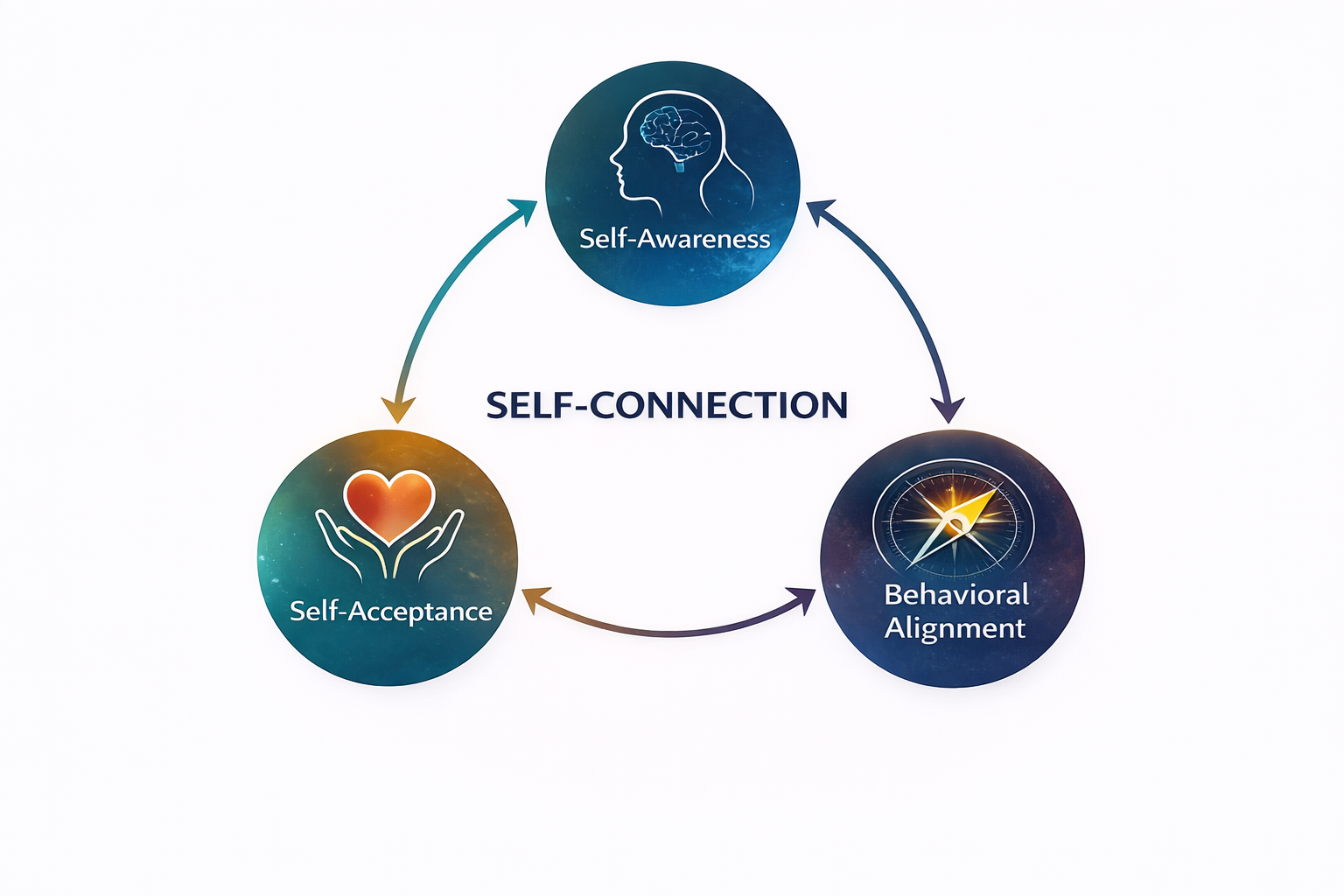
Figure 1. The Self-Connection Triad. Self-connection is conceptualized as a dynamic system consisting of three interrelated components: self-awareness (recognition of internal states), self-acceptance (non-judgmental openness to those experiences), and behavioral alignment (acting in accordance with one’s values and identity). These components function cyclically, such that each reinforces and sustains the others (Klussman et al., 2022).
This triad closely maps onto common experiences people describe as “feeling aligned” (acting in accordance with values), “feeling clear” (having stable, coherent self-beliefs), and “living meaningfully” (pursuing purpose that feels personally significant). Evidence also suggests that mindfulness-based approaches can support well-being partly by strengthening self-connection (Klussman et al., 2020), while related constructs — such as self-concept clarity (Campbell et al., 1996), authenticity (Sutton, 2020), and meaning in life (Steger et al., 2006) — help explain how “coming back to yourself” becomes behaviorally actionable rather than merely reflective.
What does it mean to be “connected to yourself,” and why does it matter for well-being?
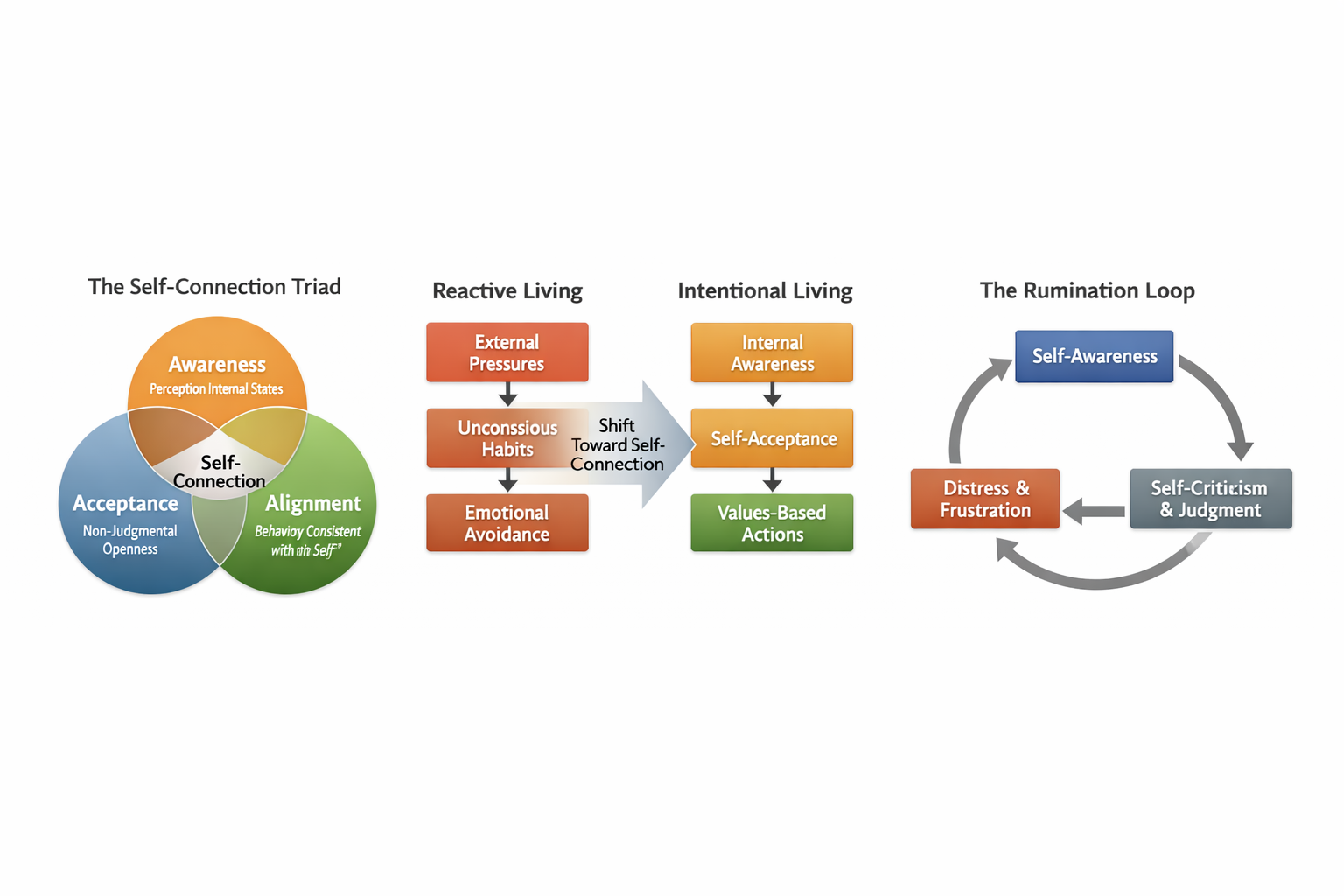
Figure 2. Self-Connection Triad, Behavioral Patterns, and The Rumination Loop. Self-connection is composed of three interrelated components — awareness, acceptance, and behavioral alignment — which together support adaptive, values-based functioning. In contrast, reactive living is characterized by external pressures, unconscious habits, and emotional avoidance, whereas intentional living reflects internally guided awareness, self-acceptance, and values-based action. When awareness is not paired with acceptance, individuals may become trapped in a rumination loop involving self-criticism, distress, and repetitive negative thinking (Smith & Alloy, 2009).
A “journey back to yourself” can be interpreted as a shift from living reactively — guided mainly by external pressures, unexamined habits, or emotional avoidance — toward living intentionally, guided by an accurate and compassionate understanding of one’s inner experience. In psychological terms, the promise of such a shift is not simply feeling better in the moment; it is improving the reliability with which a person can (1) interpret internal signals (needs, emotions, preferences), (2) respond to those signals without harsh self-judgment, and (3) translate that understanding into decisions and routines that reflect who they are. This matters because many forms of distress are not only about painful emotions; they can also involve confusion, fragmentation, and the sense that one’s actions no longer match one’s values or identity (Ryan & Deci, 2000). [2] Importantly, “returning to yourself” is not an argument for self-absorption or isolation. Human well-being depends heavily on relationships and social integration. A large meta-analysis (148 studies; over 300,000 participants) found that stronger social relationships were associated with significantly greater odds of survival (Holt-Lunstad et al., 2010). In other words, the journey “inward” is most psychologically healthy when it also supports wiser choices “outward” — including how a person builds, sustains, and repairs relationships. [3]
WHAT RESEARCH MEANS BY SELF-CONNECTION
A practical strength of the self-connection framework is that it is defined with enough specificity to guide real-world practice. Klussman et al. (2022) define self-connection as consisting of three interrelated components — awareness, acceptance, and behavioral alignment — and propose that these components work synergistically such that weakness in any one component reduces the overall experience of being self-connected (Klussman et al., 2022). [4]
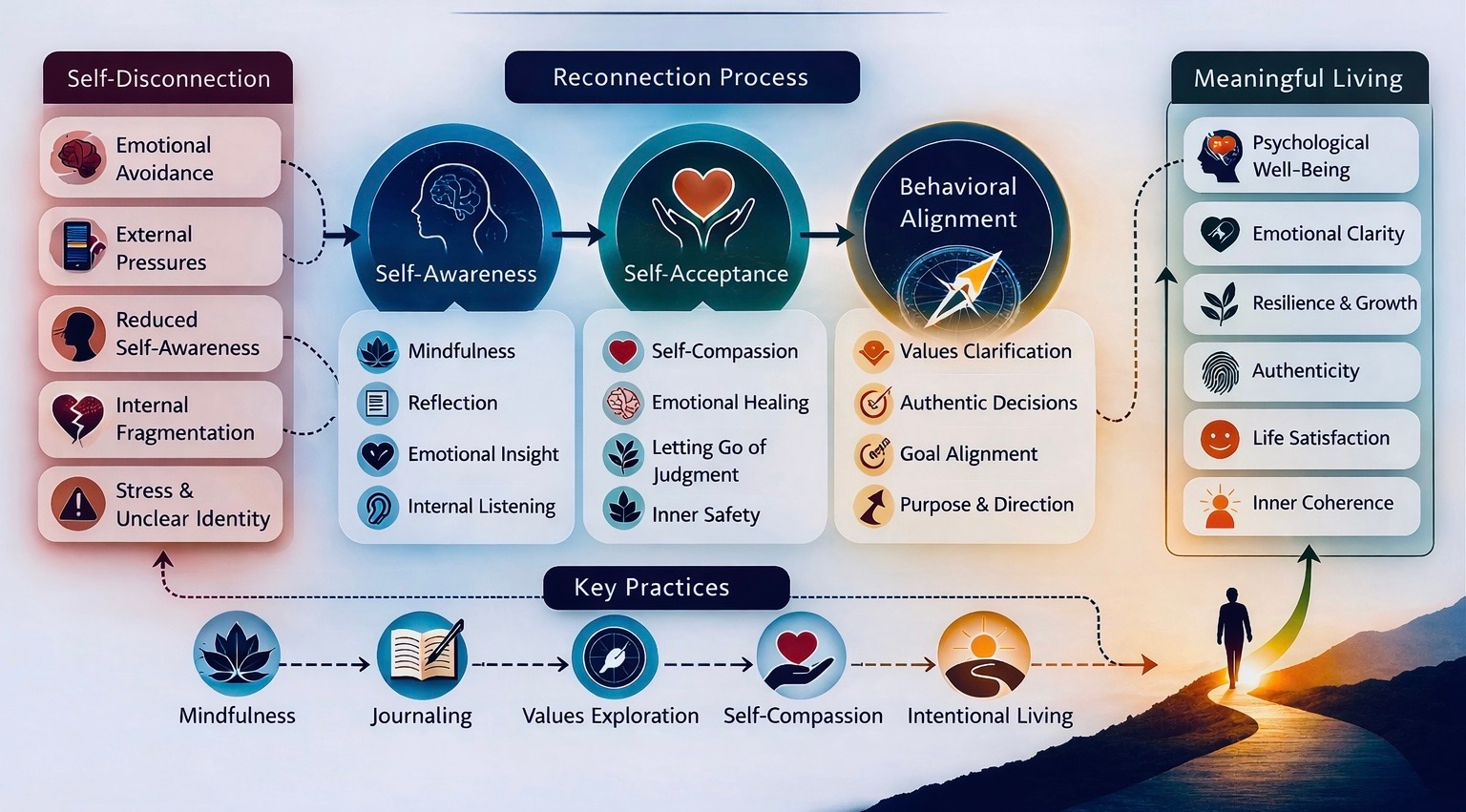
Figure 3. Psychological Pathway From Self-Disconnection to Meaningful Living. Self-connection unfolds as a transition form self-disconnection (e.g., emotional avoidance, external pressures, and internal fragmentation) to meaningful living, meditated by the development of self-awareness, self-acceptance, and behavioral alignment. This process is supported by practices such as mindfulness, reflection, emotional processing, and values-based action.
Awareness, in this context, is not merely having thoughts about oneself. It is noticing self-relevant inner information — emotions, values, preferences, and intuitions —in a way that can become usable for decision-making. Acceptance is not self-esteem and not self-indulgence; rather, it is openness to what is present internally without collapsing into shame or avoidance (Klussman et al., 2022). Alignment is the behavioral expression of self-connection: using awareness and acceptance to make choices that authentically reflect the self (Klussman et al., 2022). [5] This framework is especially useful because it clarifies a common failure mode: building awareness without acceptance. Awareness without acceptance can devolve into self-criticism, obsessiveness, or rumination— repetitive thinking focused on the causes and consequences of negative affect (Smith & Alloy, 2009). In that case, “knowing yourself more” can paradoxically increase distress if the knowing is paired with judgment rather than acceptance. [6]
WHY SELF CONNECTION SUPPORTS ALIGNMENT, CLARITY, AND MEANING
Self-connection supports “alignment” because alignment is, at minimum, coherence between inner experience and outer behavior. A closely related research tradition, the self-concordance model, argues that goals aligned with a person’s developing interests and core values (“self-concordant” goals) promote sustained effort and are associated with greater well-being over time (Sheldon & Elliot, 1999). When a person is self-connected, they are more likely to identify goals that feel self-concordant and to persist because the goals are not merely socially approved — they are personally meaningful (Sheldon & Elliot, 1999). [7] Self-connection supports “clarity” by strengthening the structure of self-knowledge. A foundational construct here is self-concept clarity, defined as the extent to which self-beliefs are clearly and confidently defined, internally consistent, and stable over time (Campbell et al., 1996). Clarity is not rigidity; it is the difference between “I am a mystery to myself” and “I can describe what I value and how I tend to respond under stress.” In practice, clarity makes it easier to set boundaries, choose environments, and evaluate tradeoffs because decisions have an internal reference point rather than being continually renegotiated in the face of pressure (Campbell et al., 1996). [8] Self-connection supports “meaning” because meaning is typically experienced when life feels coherent, purposeful, and significant from the perspective of the individual. The Meaning in Life Questionnaire (MLQ) explicitly distinguishes the presence of meaning from the search for meaning and was designed to measure meaning without simply duplicating distress measures (Steger et al., 2006). This distinction matters: searching can be healthy and growth-oriented, but it can also reflect disconnection if the search is driven by emptiness or external validation rather than values-based direction (Steger et al., 2006). [9] A complementary lens comes from existential psychology and logotherapy.
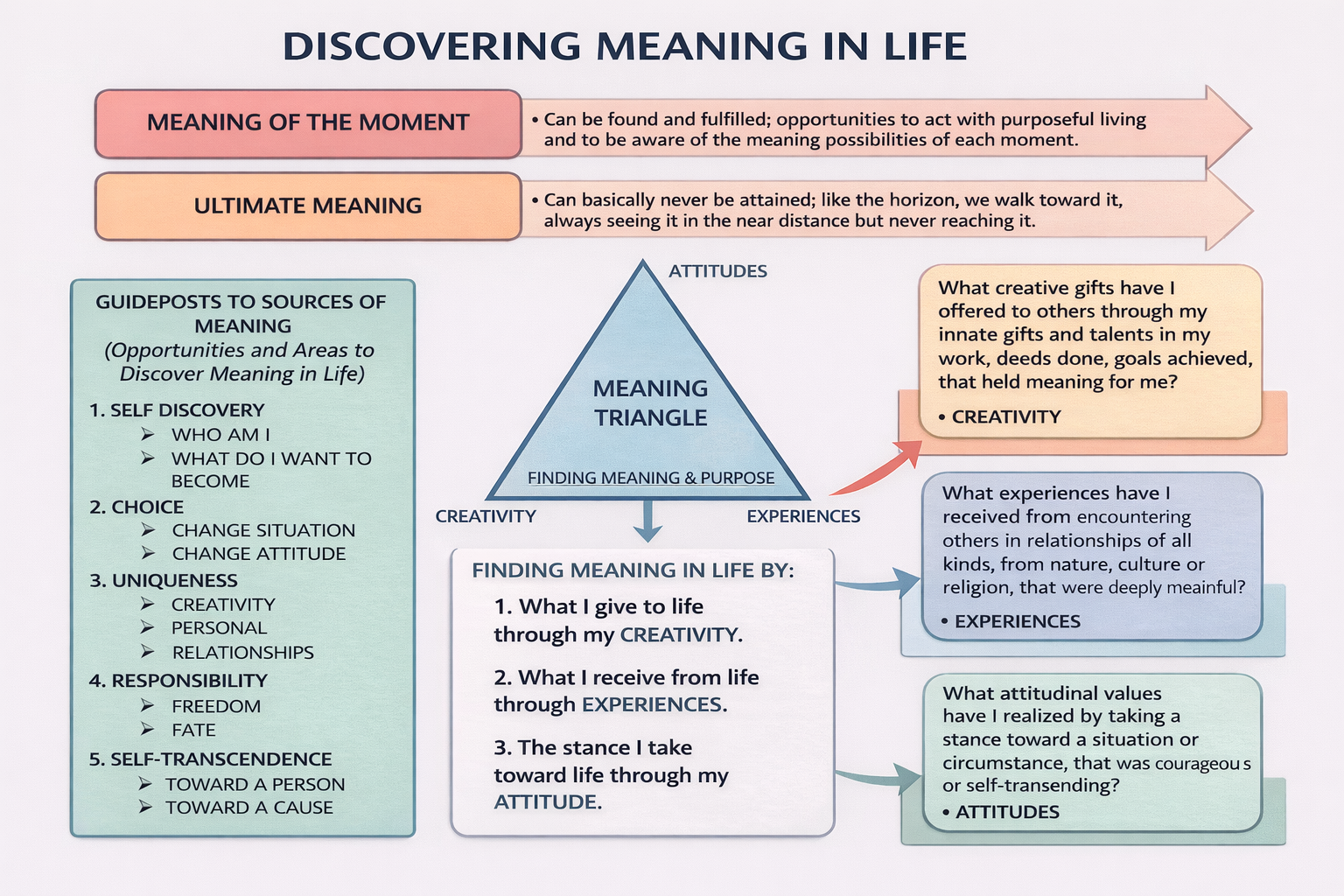
Figure 4. Discovering Meaning In Life. Meaning can be understood as emerging through multiple pathways, including creative contribution (what one gives to life), experiential engagement (what one receives from life), and attitudinal stance (how one responds to circumstances). This model, grounded in logotherapy, emphasizes that meaning is not only found in moments or ultimate purpose, but constructed through self-discovery, choice, personal uniqueness, responsibility, and self-transcendence (Frankl, 1946/2006).
Describing the premise behind logotherapy, a widely cited summary of Viktor Frankl’s work emphasizes a central idea: the primary human drive is the discovery and pursuit of what an individual finds meaningful (Frankl, 1946/2006). The relevance to self-connection is straightforward: meaning is not merely found; it is enacted — through choices that express what matters (Frankl, 1946/2006). [10] Finally, self-connection overlaps with (but is not identical to) authenticity. A large meta-analysis examining authenticity found a substantial positive relationship between authenticity and well-being (r ≈ .40) and between authenticity and engagement (r ≈ .37) across 75 studies (Sutton, 2020). In plain terms, people tend to function better and feel better when they experience themselves as living in a way that is “true to self,” which aligns closely with the alignment component of self-connection (Sutton, 2020). [11]
REFERENCES
Campbell, J. D., Trapnell, P. D., Heine, S. J., Katz, I. M., Lavallee, L. F., & Lehman, D. R. (1996). Self-concept clarity: Measurement, personality correlates, and cultural boundaries. Journal of Personality and Social Psychology, 70(1), 141–156. https://doi.org/10.1037/0022-3514.70.1.141
Frankl, V. E. (2006). Man’s search for meaning (Rev. ed.). Beacon Press. https://www.beacon.org/Mans-Search-for-Meaning-P602.aspx (Original work published 1946)
Hofmann, S. G., Sawyer, A. T., Witt, A. A., & Oh, D. (2010). The effect of mindfulness-based therapy on anxiety and depression: A meta-analytic review. Journal of Consulting and Clinical Psychology, 78(2), 169–183. https://doi.org/10.1037/a0018555
Holt-Lunstad, J., Smith, T. B., & Layton, J. B. (2010). Social relationships and mortality risk: A meta-analytic review. PLOS Medicine, 7(7), e1000316. https://doi.org/10.1371/journal.pmed.1000316
Klussman, K., Curtin, N., Langer, J., & Nichols, A. L. (2020). Examining the effect of mindfulness on well-being: Self-connection as a mediator. Journal of Pacific Rim Psychology, 14, e5. https://doi.org/10.1017/prp.2019.29
Klussman, K., Curtin, N., Langer, J., & Nichols, A. L. (2022). The importance of awareness, acceptance, and alignment with the self: A framework for understanding self-connection. Europe’s Journal of Psychology, 18(1), 120–131. https://doi.org/10.5964/ejop.3707
Lieberman, M. D., Eisenberger, N. I., Crockett, M. J., Tom, S. M., Pfeifer, J. H., & Way, B. M. (2007). Putting feelings into words: Affect labeling disrupts amygdala activity in response to affective stimuli. Psychological Science, 18(5), 421–428. https://doi.org/10.1111/j.1467-9280.2007.01916.x
Neff, K. D. (2003). Self-compassion: An alternative conceptualization of a healthy attitude toward oneself. Self and Identity, 2(2), 85–101. https://doi.org/10.1080/15298860309032
Niles, A. N., Haltom, K. E. B., Mulvenna, C. M., Lieberman, M. D., & Stanton, A. L. (2013). Effects of expressive writing on psychological and physical health: The moderating role of emotional expressivity. Anxiety, Stress & Coping, 27(1), 1–17. https://doi.org/10.1080/10615806.2013.802308
Sheldon, K. M., & Elliot, A. J. (1999). Goal striving, need satisfaction, and longitudinal well-being: The self-concordance model. Journal of Personality and Social Psychology, 76(3), 482–497.
Smith, J. M., & Alloy, L. B. (2009). A roadmap to rumination: A review of the definition, assessment, and conceptualization of this multifaceted construct. Clinical Psychology Review, 29(2), 116–128. https://doi.org/10.1016/j.cpr.2008.10.003
Steger, M. F., Frazier, P., Oishi, S., & Kaler, M. (2006). The Meaning in Life Questionnaire: Assessing the presence of and search for meaning in life. Journal of Counseling Psychology, 53(1), 80–93.
Sutton, A. (2020). Living the good life: A meta-analysis of authenticity, well-being and engagement. Personality and Individual Differences, 153, 109645. https://doi.org/10.1016/j.paid.2019.109645