
THE POWER OF PRESENCE: THE QUIET STRENGTH OF BEING HERE
SERGIO SHAN-LEE | TO BE MORE HUMAN
Why does “trying harder” so often make us feel less alive?
The power of presence is often overlooked in a world that rewards constant effort and performance. Yet learning to simply be here may be one of the most transformative psychological shifts we can make.

Figure 1. Conceptual representation of presence as psychological spaciousness and grounded attention. The image reflects the article’s central theme that presence is not performance, but a return to direct experience, inner steadiness, and clarity.
Illustrated by To Be More Human.
Understand that a large part of modern suffering isn’t the difficulty of life — it’s the constant self-monitoring we do while living it. Psychology has long described impression management as the process of shaping how others perceive us — often through image-protecting behaviors, strategic self-presentation, and subtle monitoring of how we’re coming across. That’s not inherently bad. In fact, some impression management is normal social intelligence. But when “being perceived well” becomes our default operating system, it carries costs. Research has linked greater impression management to lower life satisfaction, with factors like reduced sense of control and increased loneliness helping explain why. There’s also a motivation layer: when life becomes anchored to external validation (praise, status, approval), the inner system tends to fragment. Research within self-determination theory emphasizes that well-being is supported when our basic psychological needs—autonomy, competence, relatedness—are met, and that need frustration is associated with diminished motivation and wellness. So the shift into presence is not just “calming down.” It’s reclaiming authorship — moving from a life organized around how you appear, to a life organized around what is real. [7]
WHAT PRESENCE IS AND WHAT IS NOT
In research and clinical contexts, presence is often discussed through the lens of mindfulness: a trainable capacity for present-moment awareness. A widely cited working definition describes mindfulness as awareness that arises through paying attention on purpose, in the present moment, and nonjudgmentally as experience unfolds. Operational models emphasize that mindfulness involves both (1) regulating attention toward the present and (2) adopting an attitude of openness and acceptance toward whatever is noticed. Presence is not: – a performance of calm, – an attempt to empty the mind, – a bypass of emotion, – a spiritual personality trait you either “have” or “don’t have.” Presence is: – the ability to return — again and again—to what’s happening right now, – the willingness to stay with experience without instantly editing it, – the capacity to meet your life directly instead of living through a running commentary about your life. In TBMH language, presence is the doorway: the place where clarity emerges — not because you controlled your thoughts, but because you stopped abandoning yourself mid-moment.
WHY WE LOOSE OURSELVES IN PERFORMANCE MODE
The human mind is built to simulate: to revisit the past, rehearse the future, and run “what-if” loops. The science term for this is mind wandering — stimulus-independent thought that pulls attention away from what’s happening right now.
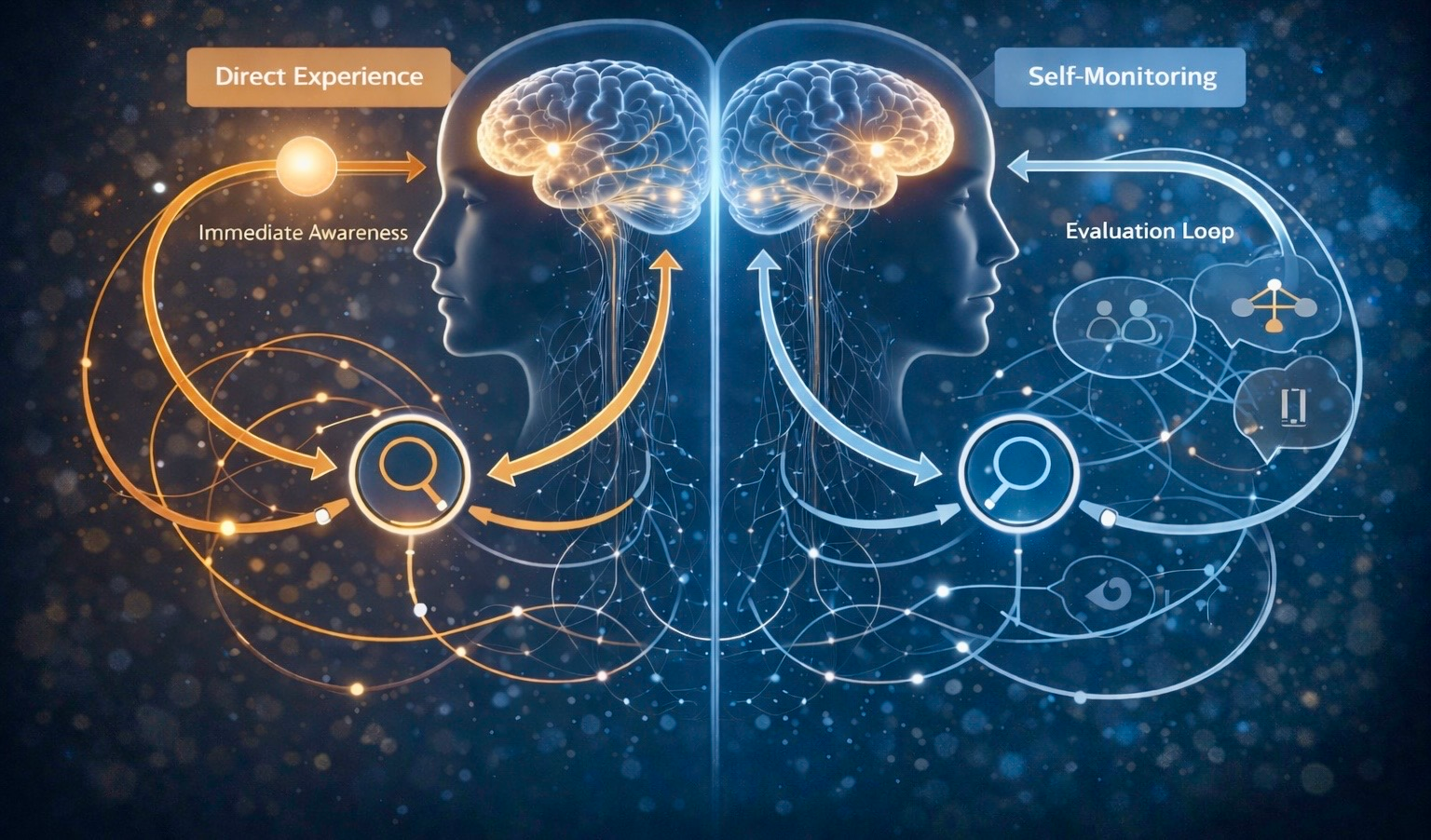
Figure 2. Conceptual Model of Divided Attention Under Performance Mode. The figure illustrates the split between direct experience and self-monitoring described in the article, showing how attention becomes fragmented by evaluation, impression management, and internal pressure.
Illustrated by To Be More Human.
The human mind is built to simulate: to revisit the past, rehearse the future, and run “what-if” loops. The science term for this is mind wandering — stimulus-independent thought that pulls attention away from what’s happening right now. In a large experience-sampling study published in Science, people’s minds wandered during a substantial portion of their daily lives (nearly half of the time in that dataset), and greater mind wandering was associated with lower reported happiness. Reviews of mind-wandering research describe it as common and multi-functional (planning, creativity, problem simulation), while also noting its association with performance costs and emotional drift when it becomes uncontrolled. Performance mode (the inner posture of “How am I doing? How am I being seen?”) intensifies this wandering because it adds evaluation pressure. Your attention fractures: part of you is living, part of you is watching yourself live. Presence becomes power precisely because it ends that split. [8]
THE SCIENCE OF RETURNING TO THE MOMENT
Mindfulness-based interventions are now studied across clinical and non-clinical contexts, with a growing body of randomized trials and systematic reviews. A major systematic review and meta-analysis in JAMA Internal Medicine found that meditation programs (including mindfulness approaches) can produce small-to-moderate reductions in dimensions of psychological stress such as anxiety and depression, while also emphasizing limits in evidence quality for some outcomes and the need for stronger study designs. Presence also relates to attention in a very practical way: mindfulness training can reduce distraction and mind wandering while improving aspects of cognitive performance. For example, a randomized study in Psychological Science reported that a brief mindfulness training improved working memory and reading comprehension outcomes while reducing mind wandering during testing. Mechanistically, contemporary frameworks describe mindfulness training as building two core skills: monitoring (noticing what’s happening in real time) and acceptance (changing how we relate to what we notice). Together, these skills are theorized to reduce reactivity and improve emotion regulation, attention, and stress responses. Some neuroimaging research also suggests that participation in an 8-week mindfulness-based program can be associated with structural brain changes in regions involved in learning and memory, emotion regulation, and self-referential processing — findings that are intriguing and widely discussed, while still best interpreted with appropriate scientific caution (sample sizes, replication, and methodology matter). Presence is not just poetic language. It is a trainable attentional stance with measurable psychological correlates—and, for many people, meaningful emotional relief. [20]
LISTENING TO INNER INTELLIGENCE
The phrase “inner intelligence” can sound mystical — until you translate it into what neuroscience can actually observe. One grounded way to understand inner intelligence is interoception: the sensing and interpretation of internal bodily signals (e.g., breath, heartbeat, hunger, warmth, tension).

Figure 3. Conceptual Model of Interoceptive Awareness. The figure illustrates how internal bodily signals contribute to awareness, feeling states, and the brain-body processes discussed in the article’s section on inner intelligence.
Illustrated by To Be More Human.
A major review in Nature Reviews Neuroscience describes interoception as the sense of the physiological condition of the body and links it to how feelings arise from bodily states. Neuroscience research also points to the insula as an important region supporting interoceptive awareness and subjective feeling states. This matters because “being present” isn’t only mental. It’s also somatic. Often, the most accurate truth in a moment appears first as body-signal: a constriction in the chest, a subtle agitation, a quiet openness, a sense of ease, a wave of fatigue. Related theories in decision science propose that bodily-emotional signals can influence judgment and choice — suggesting that part of what we call “intuition” may involve learned body-based markers associated with past outcomes. So when you stop performing and start listening, you’re not “becoming passive.” You’re becoming accurate — tuning into the earliest data your system provides before your mind turns it into theater. [25]
PRACTICES TO BUILD PRESENCE IN REAL LIFE
Presence becomes power when it becomes portable — something you can access in real conversations, tense meetings, conflict, silence, and ordinary routines. The goal is not perfect stillness; the goal is a reliable return. A practical foundation is to work with three layers: attention, emotion, and body. First, interrupt the performance loop with one clear anchor. Mindfulness training often uses an attention object (like the breath) not because the breath is magical, but because it is always available, and returning to it trains attentional control. Second, name what you’re feeling — out loud or silently. Neuroimaging research on affect labeling found that putting feelings into words can reduce amygdala and limbic reactivity relative to other forms of encoding, while increasing activity in prefrontal regulatory regions. Third, use breath strategically, not spiritually. A systematic review and meta-analysis on voluntary slow breathing reported increases in vagally mediated heart rate variability across measurement time points, supporting the idea that paced breathing can influence autonomic regulation. A simple weekly rhythm you can adopt: – Daily (2 minutes): “Arrive” practice — place attention on one sensation (breath, feet on the floor, hands) and repeatedly return when the mind wanders. – Daily (30 seconds): “Name it” — “I’m noticing anxiety” / “I’m noticing pressure” / “I’m noticing sadness.” – As needed (60–90 seconds): Slow breathing — steady, comfortable inhales and longer exhales. And one final shift, because the deepest performance loop is motivational: choose internal alignment over external reward. Research in self-determination theory argues that well-being is supported when actions feel self-endorsed (autonomy) and connected (relatedness), rather than driven primarily by externally controlled motives. Presence is what becomes possible when your attention stops auditioning — and starts inhabiting. [8]
REFERENCES
A Wandering Mind Is an Unhappy Mind (Science, 2010). [13]
How do you feel? Interoception: the sense of the physiological condition of the body (Nature Reviews Neuroscience, 2002). [21]
Meditation Programs for Psychological Stress and Well-Being: A Systematic Review and Meta-analysis (JAMA Internal Medicine, 2014). [16]
Mindfulness Training Improves Working Memory Capacity and GRE Performance While Reducing Mind Wandering (Psychological Science, 2013). [17]
Mindfulness: A Proposed Operational Definition (Clinical Psychology: Science and Practice, 2004). [32]
Mindfulness-Based Interventions in Context: Past, Present, and Future (American Psychologist, 2003). [8]
Neural systems supporting interoceptive awareness (Nature Neuroscience, 2004). [22]
Putting Feelings Into Words: Affect Labeling Disrupts Amygdala Activity in Response to Affective Stimuli (Psychological Science, 2007). [26]
Self-Determination Theory and the Facilitation of Intrinsic Motivation, Social Development, and Well-Being (American Psychologist, 2000). [6]
The Benefits of Being Present: Mindfulness and Its Role in Psychological Well-Being (Journal of Personality and Social Psychology, 2003). [33]